
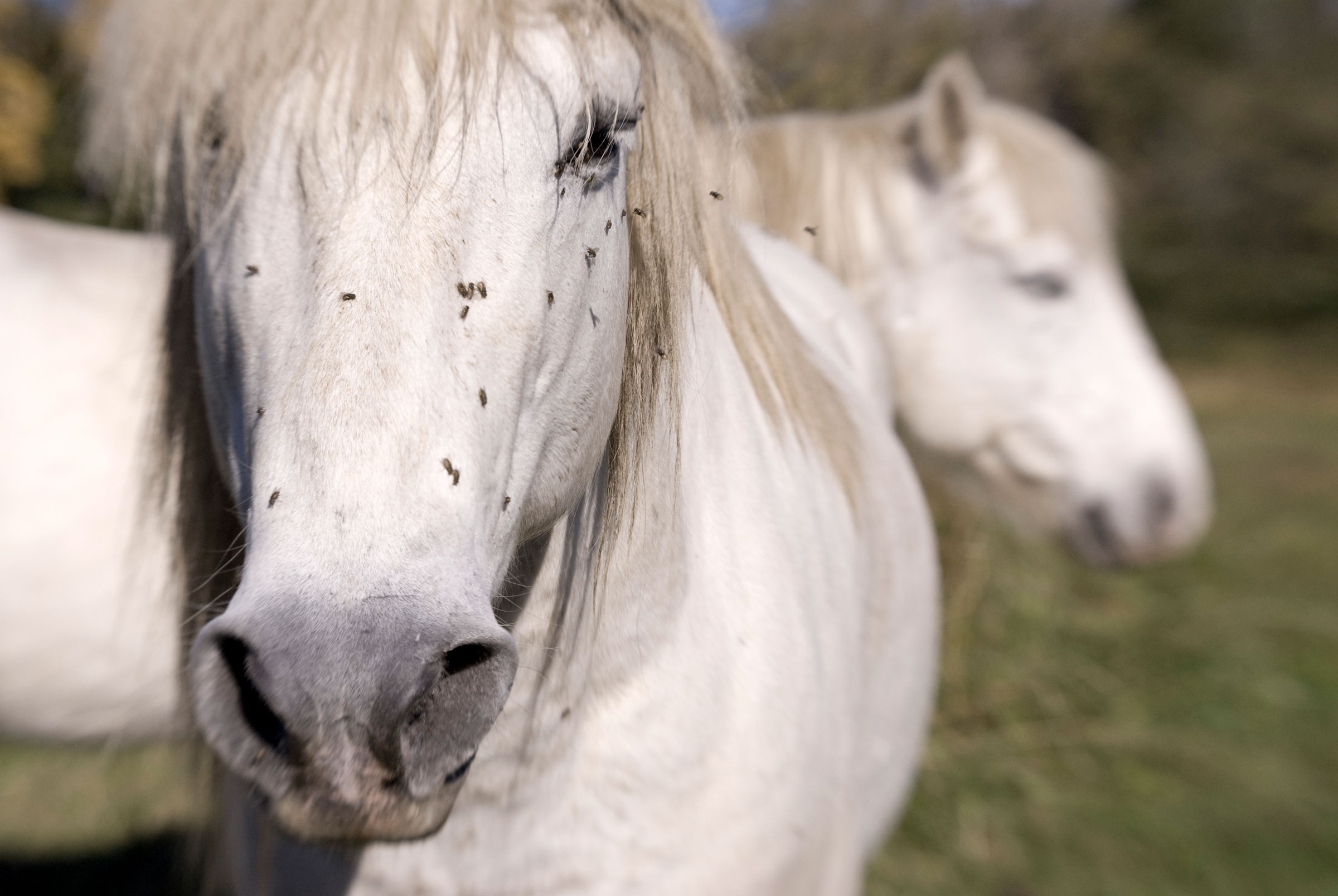
How can you as the owner or manager of a horse farm or stable reduce the fly burden on your property? You know that flies can irritate horses and humans, sometimes to the point of endangering one or both. Horses stomp when flies land on their legs, potentially causing damage to their legs and feet. Flies can create sores on horses, they carry diseases, and they annoy not only you, but your neighbors.
So what can you do?
Here are some helpful tips to help you decrease the flies, thus decreasing their negative impact on you, your horses and the people around your facility.
Manure Management
Flies live and reproduce in your horses’ manure, so you need to attack them where they start. Keeping stalls and runs clean is the first step. Spreading the manure is the best solution, breaking up and drying out the flies’ home will decrease their presence. Spreading is a science in itself; know how much manure you’ve got and don’t overspread on small acreages. A good rule of thumb for spreading is one horse’s manure for every five acres. Of course, you should check with your local agriculture extension agent for specifics in your area.
If you do pile, consider location as well as composting. However, a large pile is a prime location for fly reproduction.
General cleanliness follows in this vein. Don’t allow for standing water near your corrals, clean water buckets weekly, keep grain covered and sweep up excess hay, muck and dust in the barn.
Bugs vs. Bugs
In recent years, fighting flies with other insects has become a desirable solution for horse owners wary of chemicals. As with any method, there are several options. The first is fly predators, tiny wasps that don’t sting animals or people. These beneficial, tiny insects can easily control flies.
Fly predators kill flies in their developing stages while they are in the ground. The female fly lays her eggs wherever there is decomposing organic material. Those eggs hatch and become larvae, which eventually form a cocoon before hatching into the next generation of flying pest. When you spread the fly predators in that area, the tiny wasps lay eggs in the fly cocoons, thus stopping the adult fly from hatching.
Fly predators must be replenished on a regular basis to ensure that you have the best fly control. They don’t become a nuisance, because they have a very short life span.
Finally, an adult fly’s natural enemies are birds and bats. While you may already have birds around your barn, bats are easy to attract with the use of a bat house placed on the southern side of your barn.
Fly Traps
Even with the advantages of the above and below listed techniques, flies will likely appear at your barn. A single fly can produce up to 1,000 offspring within a month. Trapping them is an effective and fulfilling way to kill the ones that got away.
The most common trapping products are jars filled with an attractant, either natural or chemical, which lures flies in where they can’t escape. Another effective and time-honored method is fly paper. Place either or both of these contraptions liberally throughout your barn, runs and corrals. If your house happens to be near the barn, you may even want to put a jar near the back door.
Chemical Attack
The chemical aspect of fly control ranges from automatic misters set up to control an entire barn to feed-through fly control to bottles of fly spray. Look for the chemicals pyrethrin, cypermethrin and permethrin in any of the spray fly control products.
There are numerous variations of chemical applications for horses. Some are vapor repellants, which merely keep the fly from landing on your horse. Others, which usually contain permethrin, are lethal to flies, and the fly will die shortly after it lands on your horse. Many products contain a combination of pyrethrin and permethrin: a fly spray and repellant combination.
Spray on, spot on, wipe on, sweat-proof, long-lasting, sun screen, coat conditioning, wound safe and all-natural are options from which to choose. To decide what’s best for you, consider how often your horse is out of the barn. If he’s out of an otherwise fly-free barn for a few hours a day, a simple vapor spray-on might be best. For show horses, a coat-conditioning fly spry might be right. If you’ll be working your horse outside all day, consider a sweat-proof spray with sunscreen protection. For mares or retired horses turned out to pasture, you should look into a long-lasting wipe. Thin-skinned horses might need a diluted or all-natural spray. Basically there is a broad enough spectrum that you’re sure to find one that best suits you and your horse.
For a larger-scale attack, the automatic misters are very effective. Most companies will work with you to customize a program that will most efficiently combat the fly problem in your barn. Again, the options are nearly limitless in regard to the kind of spray you use.
Finally, the feed-through fly control options are worth considering. If you do choose a feed-through option, you should begin the regimen in spring, before you see the first flies. However, it is never too late! Feed-through fly control stops the larvae, but not adult flies, so you will need to use other control measures as well.
Fly Control Apparel
On-horse fly control is the final method of defense against flies. Fly masks and sheets are the most common, and some companies offer head and face protection products with ears. Fly wraps are also an option. These devices are breathable mesh wraps that wrap around the horse’s lower leg and can eliminate stomping and pawing.