
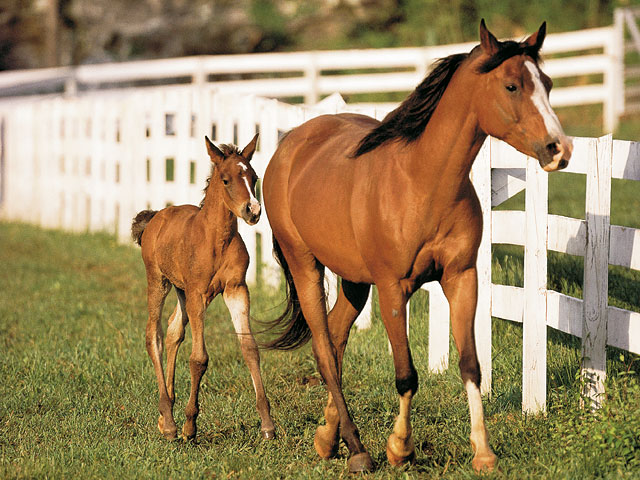
If you have a mare, it’s natural to wonder if her foal could be your next dream horse. For many people, breeding and raising horses of their own is deeply rewarding. But the journey from conception to rideable horse is long, labor-intensive, and expensive—with no guarantees.
“Horses chosen for breeding are usually selected based on athletic ability, and their owners are committed to passing on their genes,” says Rachel Doenges, DVM, a theriogenology resident at Rood & Riddle Equine Hospital in Lexington, Kentucky. The veterinarian, who successfully bred her own sporthorse mare after a career-ending injury, challenges horse owners to take an ethical, responsible approach to equine reproduction by also considering the individuals’ general health, soundness, and temperament before taking the plunge. Let’s review what responsible breeding decisions look like in practice.
It’s a Match: Mare and Stallion Selection
Ideally, a mare owner selects a stallion that will enhance the dam’s qualities and counterbalance any weaknesses. This principle applies to her conformation, talent, and temperament. Additionally, our experts say any horse—mare or stallion, of any breed or discipline—being considered for breeding should be evaluated for the following:
Soundness. “Many sport horse mares become broodmares simply because they are no longer sound for riding,” Doenges says. But do consider the cause of lameness before deciding to breed, she adds. Did your healthy, fit, sound mare retire due to a freak accident? That might not be a dealbreaker if her body can still withstand the stress of pregnancy and labor. But what if the source of lameness that led to her premature retirement was linked to a heritable condition?” Think podotrochlosis (aka navicular syndrome), or repeated suspensory ligament injuries (potentially associated with degenerative suspensory ligament desmitis, or DSLD).
“The reality is that heritable issues can make injury more likely, and many disorders that are suspected to have heritable components are also dependent on other factors like young horse management,” Doenges says. “If you are considering breeding a horse that has a condition that is suspected to have a heritable component, you, as a breeder, must decide your risk tolerance.”
General health. “We tend to focus on performance and athletic ability, but we need to consider general health, too,” says Doenges. “Firstly, obviously, we do not want to perpetuate hereditary health conditions in offspring. Secondly, you must evaluate the mare’s ability to have a successful and comfortable pregnancy.”
Illness and injuries become more challenging to manage when mares become pregnant (and gain 100-150 pounds). The mare’s body must devote significant energy and resources to the foal during pregnancy and lactation, which can compromise her health, says Doenges. “If the mare has a health condition—take, for example, chronic laminitis—that is poorly regulated pre–pregnancy, her fertility and ability to successfully carry a foal to term will be compromised.” In short, mares should be generally healthy and, at the very least, pasture sound to be considered as breeding candidates.
Temperament. “Both genetic and environmental factors influence the temperament of the foal,” Doenges explains. “If you are breeding a mare with an undesirable disposition, she not only will be contributing genetically, but she will also model these behaviors to the foal.”
Genetic Testing in Horses: Is it Worth it?
For Jennifer Linton, VMD, Dipl. ACT, of B.W. Furlong & Associates, in Oldwick, New Jersey, pre–breeding genetic testing recommendations depend on the health history of the individual horse, his or her relatives, and the breed or registry. “If there are any cases of testable genetic diseases in the patient’s family tree, we test to ensure the patient isn’t a carrier,” she explains. Such conditions commonly include hyperkalemic periodic paralysis (HYPP), polysaccharide storage myopathy (PSSM), equine systemic proteoglycan accumulation (ESPA, also known as DSLD). If the horse has no relevant history and the breed registry has no requirements, Linton leaves the genetic testing decision up to the owner.
Line Breeding vs. Inbreeding in Horses
Thoroughbred horse racing gives a prime example of line breeding, with the pedigrees of all 19 Thoroughbreds in the 2025 Kentucky Derby containing the famous 1973 Triple Crown winner, Secretariat. Unlike the frowned-upon practice of direct inbreeding—mating individuals who are genetically closely related, such as parent-offspring or siblings—line breeding is used successfully in horse breeding without carrying the same risk of genetic anomalies.
The goal of line breeding—producing offspring from individuals sharing distant ancestors—is to concentrate and maximize the influence of an exceptional ancestor. Line breeding technically is a form of inbreeding, but a much more dilute, genetically safer one.
“The best example I have of direct inbreeding impacting genetic health is the Friesian breed,” says Linton. “During World War I, the breed’s genetic pool was decimated, and the resulting breeding stock is now carefully monitored to prevent extremely closely related horses from breeding.” That’s for good reason—she explains that many of the genetic conditions seen in today’s Friesians (such as megaesophagus [a condition affecting the esophagus’s ability to move food to the stomach] and a high rate of retained fetal membranes) are likely due to breeding from such a small genetic pool just over a century ago.
Man-Made Fertility Challenges in Horses
Since many performance horse mares don’t conceive their first foal until they retire from competition, time isn’t on their side. “One of the most challenging aspects of using a retired sporthorse for breeding is that the owner might perceive them as a young, ideal breeding candidate,” Doenges says. “But the reality is, mares even in their early teens are at an age that is associated with changes in fertility,” a fact that’s well-supported by research.
“Older maidens (mares that haven’t had foals before) can be especially challenging,” she adds. “These mares often require more aggressive management to achieve pregnancies. These challenges are sometimes insurmountable, and alternative ways to produce a foal, like oocyte aspiration or embryo transfer, may be the only options.”
While horse owners commonly use these procedures, Doenges warns they can be costly and time-consuming. Therefore, she recommends working with a veterinarian willing to take time to guide you through the process.
To add another layer of complexity, breeders rarely select an individual to breed based on fertility. “I do think we have, at least in some breeds, selected for type and look rather than function,” says Linton. “I see this most in terms of fertility—when selecting stallions for breeding stock, we mostly consider their performance and not their semen quality. In other species, sire fertility links to both male and female offspring fertility. In breeding subfertile stallions, are we creating a generation of mares that will also be difficult to breed?”
Take-Home Message
Breeding a horse encompasses far more than pairing two animals—it’s about making responsible, ethical choices that shape the future of the equine population. Both mare and stallion should be healthy, sound, and well-tempered, and breeders should pay careful attention to avoiding hereditary conditions or close inbreeding. Also consider age, fertility challenges, and the demands of pregnancy, along with the financial and time commitments involved. Thoughtful, informed decisions not only protect the welfare of individual horses but also ensure the next generation has the best chance to thrive.