
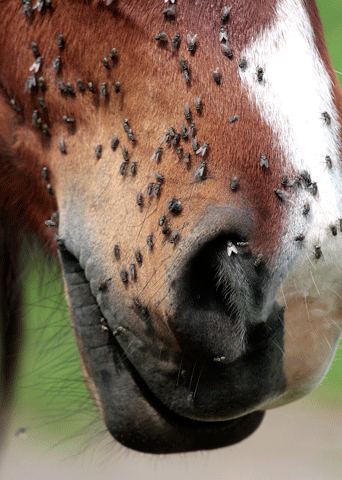
Tail swishing. Foot stomping. Skin twitching and head throwing. No, these aren’t new dance moves; they’re avoidance behaviors your horse exhibits when he’s trying to rid himself of pesky flies and other annoying insects that swell to annoying levels with the coming of warmer weather.
But insects don’t just harass your horse—their bites can cause welts and rashes, lead to insect bite hypersensitivity, and even transmit diseases such as Eastern and Western equine encephalomyelitis, equine infectious anemia, vesicular stomatitis, and West Nile virus.
Insects can also affect your horse’s weight and hoof condition. “If you have a horse in turnout, particularly if he’s on the thin side and you’re trying to put weight on him, you don’t want him expending calories from constantly pacing and swatting,” says Krishona Martinson, PhD, equine extension specialist and co-author on a recent University of Minnesota (UMN) study of fly-fighting methods. “Likewise, if you’re trying to rehab a damaged hoof, the last thing you want is for your horse to be constantly stomping.
“You have to consider each horse’s needs when strategizing his care,” she adds. “In cases such as these, you might want to buy all the fly gear—fly sheets, masks with ears, leggings, leg bands, and fly spray—to keep insects at bay.”
Martinson, UMN emeritus entomologist Roger Moon, PhD, and graduate student Rachel Mottet measured horses’ avoidance behaviors under various insect-control methods, and what they found can help you most effectively control the pests that pester your horse.
The Study
The researchers measured fly avoidance behaviors of six horses, each of which received a different insect-control treatment once a week for six weeks. At the end of each week’s treatment, the horse received a bath to remove dirt, dust, and any residual product.
Insect control methods included a commercially available pyrethrin spray (made from compounds that occur naturally in African chrysanthemum flowers), a commercially available pyrethroid spray (synthetic chemicals, including permethrin, that act like pyrethrins), a water-based citronella spray recipe, leg bands containing fly deterrents, leggings (aka fly boots), and no treatment.
Students counted per-minute occurrences of four insect avoidance behaviors—tail swishes, shoulder twitches, “head-backs” (moving the head toward the body or limbs), and hoof stomps—over a two-hour period in afternoons following application of each insect control method.
The findings? Surprisingly, they say, leggings, leg bands, and citronella spray most effectively reduced the avoidance behaviors, but no one treatment reduced all the behaviors.
Before we cry foul about the seemingly less-effective pyrethrin and pyrethroid spray treatments, Martinson says we need to look at the overall study.
“We mixed the spray concentrates according to manufacturer directions to the best of our ability in identical spray bottles, and to get the correct amount on the horse, we counted how many times we pressed the spray-bottle trigger,” she says. “Although all the horses weighed approximately 1,100 pounds, their weights did vary. So we have to ask if we used enough concentrate in the spray mixture, if each sprayer sprayed identical amounts, and if each horse received spray in identical doses according to its weight.
“All the products we used tended to bring down the numbers of avoidance behaviors,” she adds. “But none of the products resulted in complete elimination of fly activity or fly avoidance behaviors.”
Consider the Climate
Moon poses an important question: How long do fly sprays last on horses? “Longevity of leggings, bands, and citronella sprays may not depend so much on weather, but duration of pyrethrin and pyrethroid sprays can depend on environmental exposure,” he says. “Pyrethrins and pyrethroids decay faster outdoors than indoors due to exposure to UV rays. And regardless of where horses are housed, pyrethrins break down faster than pyrethroids. Degradation also occurs faster when horses are exposed to moisture, either from rain; from working in deep, wet vegetation; or from working hard, to a sweat or lather.”
“You really have to read the labels,” says Martinson. “Labels on the sprays we used recommended keeping the product in a climate-controlled area out of direct sunlight, and you’ll notice that commercial sprays come in colored bottles to avoid exposure to light. Even when we were out in the field, we kept the bottles in a cooler to make sure they didn’t get exposed to sunlight or become overly hot.
“Labels are really good at outlining directions for storing, with upper and lower temperature values to make sure that the active ingredient stays intact,” she adds.
Focus or Avoid?
Another consideration when assembling your anti-bug armor is how and where to apply sprays. “You have to think about where flies want to attack, and respond accordingly,” Martinson says. “Frequently, the whole horse needs some type of treatment.”
Stable flies, for instance, like to attack horses’ legs, so leg bands and leggings are effective in addition to or instead of fly sprays, she says.
“Insects also like moisture, so you’ll need some protection around the horse’s face—particularly the ears, eyes, and nose,” Martinson says, noting her team used masks with covered ears on all their study horses. “The horse’s body is also an insect target, and we’ve all seen horses getting eaten raw from gnats, especially where their legs come into their chest and mares around their udders.”
But some areas are spray no-nos: Avoid udders and teats, especially when mares are nursing. “You don’t want a foal to not want to nurse because the area smells or tastes funny,” Martinson says. “Instead, you can wipe spray on the inside of the mare’s legs to keep her comfortable.”
Avoid other sensitive areas, including genitals and wounds, and be cautious around a horse’s face, especially his eyes, nostrils, and mouth. “You can hand-wipe those sensitive areas (or use roll-ons) if for some reason you can’t use a mask,” she says. “And just like humans, some horses have sensitivities to different kinds of fly sprays. So if you notice that a horse you sprayed comes down with hives, discontinue that spray.”
Spray the Right Way
Insect spray isn’t cheap, so you’ll want to make sure you get the best results from the least amount of product—and time spent applying it.
Always start with a clean horse. Although you don’t need to bathe your horse before you spray, you do want to groom him to remove loose hair and dirt.
Follow the manufacturer’s label instructions for application. Some advise wiping versus spraying, while others recommend brushing hair against its growth while spraying so the spray reaches hair roots and skin. Some advise wearing goggles to avoid contact with eyes, and some suggest wearing protective clothing such as long sleeves and pants or spraying outdoors.
Mind the frequency. Although some commercial product labels claim efficacy for up to 14 days or longer, Moon says not to expect it to exceed a day under the best of outdoor conditions.
Train your horse to stand for spray (TheHorse.com/112298). You don’t want to waste half the bottle spraying the air around a dancing, jigging horse that doesn’t realize you’re trying to help him.
Integrated Pest Management
Your goal is to keep your horse comfortable, which might require extra effort during insect season. To that end, you might have to employ a variety of techniques to both repel and kill insects.
“Fly sprays by themselves aren’t going to be cure-alls,” Martinson says. “Fly control is a comprehensive strategy, and the biggest component is simply good housekeeping.” Without it, you’ll work double duty to keep insect populations down.
First on your to-do list: manure management. “Remove old bedding on a daily basis, and if you have old feed, put it on the manure pile as well,” she says. “And make sure your manure pile is as far from your horse as possible.”
If you compost your manure, turning it weekly encourages hot composting, which kills immature houseflies and stable flies, adds Moon.
Because flies are attracted to moisture, “fix any leaky faucets that could cause a puddle,” says Martinson.
Residual premise sprays also help, as do screens on stable openings where practical; just be sure screens do not impede barn ventilation.
Avoid turning horses out at peak insect feeding times. “We know that mosquitoes come out at dawn and dusk, so put your horse away during those times, and let him out when the mosquitoes are less active,” Martinson says. “Other biting flies are active during the daytime, so watch your horse for fly aversion behaviors that will tell you he’s being bothered.”
If you don’t have a barn, be sure pastured horses have shade and shelter they can take advantage of during fly season.
Take-Home Message
Our responsibility as horse owners is to keep our horses healthy, safe, and comfortable. Building an effective fly-fighting arsenal can help us do just that.