
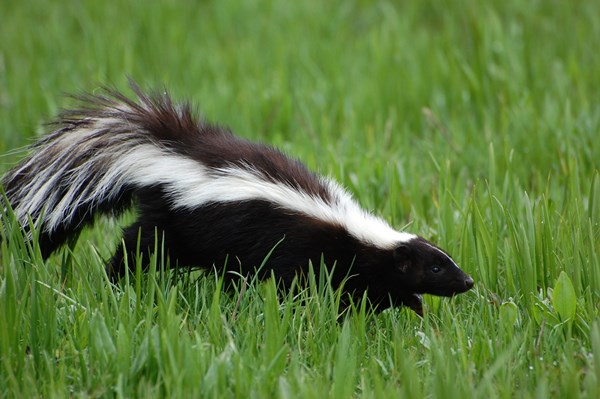
One night around 9 p.m., long after the sun had set, I headed out with my two dogs to do the last of the day’s three feedings at our 12-horse boarding facility. The dogs bounded happily past me out the door and around the corner, status quo, the three of us oblivious to anything out of the norm. As I strolled under the light at the front of our barn, however, I caught sight of the dogs standing over something ahead of me, wagging their tails intently. A handsome young skunk was boldly showing them the backside of his tail. You can probably guess what happened next.
My dogs made a mad dash away from the two-tone visitor and rolled in the snow, desperately trying to rid themselves of his perfume. The skunk, unconcerned, shuffled off, and I began making plans for where the dogs would sleep that night and how I’d get them clean the next morning.
This all goes to say that some wildlife in and around our barns might be desirable, such as barn swallows, each of which consumes around 800 soft-bodied flying insects per day (better than a bug zapper), or barn owls, a family of which can consume up to 3,000 rodents a year. Or, you might just enjoy watching a herd of deer or elk graze in your back pasture.
But other wildlife, such as my dogs’ fragrant foe, pose drawbacks, causing situations like ours or, worse—acting as vectors for diseases. These animals can pass along pathogens (disease-causing microbes) such as the bacteria that cause leptospirosis, which can lead to abortion, chronic uveitis, and/or kidney failure in horses; hantavirus, which can infect and cause a rare lung disease in humans; or the deadly rabies virus, which can infect horses, humans, and a variety of other mammals. Out-of-control unwanted critters can also damage property and structures or create unhygienic messes.
In this article we will explore ways to deter unwanted visitors and prevent the complications they can cause.
Dissuade and Deter Unwanted Wildlife
When it comes to dealing with problem animals, “there is no magic bullet,” says Stephen M. Vantassel, MNI, CNI, CWCP, ACP, the vertebrate pest specialist for the Montana Department of Agriculture and former program coordinator of wildlife damage management for the University of Nebraska-Lincoln School of Natural Resources. “I want to disabuse people from the idea that we just flick a switch and these (animal) problems go away,” he says. “Habitat modification, removal, and exclusion are the only three options.”
To discourage unwanted guests, begin with a few basic steps, the first of which is to eliminate wildlife habitats (desirable food, water, and shelter) on your property:
■ Do not leave cat or dog food out at night. Feed household pets indoors when possible, and pick up leftovers if feeding outdoors.
■ Store pet and livestock feed where it’s inaccessible to wildlife, such as in metal trash cans with securely fastened lids.
■ Eliminate pet water bowls, dripping water faucets, and other water sources (when possible).
■ Move bird feeders to locations where they’re less likely to cause problems if they attract rodents or small animals (which are prey for larger, possibly unwanted animals such as coyotes), or bring the feeders in at night.
■ Do not discard edible garbage or household food waste in compost or where it might attract opossums, raccoons, and other nuisance animals.
■ Secure garbage containers with proper lids.
■ Limb up shrubbery near buildings to reduce cover for small animals.
For many animals, “barns are basically a sieve, a food source with an open door,” says Vantassel. “If you have a hole into a (feed room) where grain is stored, then close up the hole. Mice can get through a 3⁄8-inch hole. If you are leaving 4-inch gaps, a raccoon can get in.”
If you want to remove or trap wildlife, first research regulations for your area. In most parts of the country, wildlife is protected, and there might be regulations on trapping approaches and disposal.
“Typically,” says Chad Soard, owner of Trifecta Wildlife Services LLC, in Lexington, Kentucky, “regulations are handled by the state wildlife department or department of natural resources. Wildlife is managed as part of public trust; if they are causing property damage, there will be laws to control them, but generally (these offices) don’t have staff to send out to do something about it.”
Soard, who has a master’s in wildlife biology and worked for the Kentucky Department of Fish and Wildlife, says, “We don’t do any poisons. Poisons, like rodenticides, require a special use permit when you are working commercially on someone else’s property and may be illegal for larger animals altogether. For the most part, they’ve been engineered to be as safe as possible with shorter elimination half-lives, but if a mouse eats it and it goes off and another animal eats it, like a fox or a hawk, then this creates a circle of death due to secondary toxicity.”
Both sources emphasize the importance of having professionals select and handle any poisons for wildlife control to eliminate secondary impacts.
But what about nonlethal control options? “There’s no evidence that auditory sonic control mechanisms work at all,” says Vantassel. “There’s some minimal evidence that rodents will avoid [ultrasonic pest repellers].”
Researchers have shown that animals habituate quickly to frightening devices such as movable plastic owls that dissuade roosting house sparrows, “yard-art” silhouette cutouts of coyotes used to scare off Canada geese, or recordings of hawk cries for chasing off starlings or other birds. So these types of devices have limited use, say our sources.
That leaves you with three options: Shoring up buildings; reducing food, water, and shelter sources for pests; and using control methods. Here’s how to handle various species.
Birds on Horse Farms
Bird problems are common. “Typically, barns are relatively open places for them,” says Soard. “Sometimes there’s access to feed. It’s a wonderful, safe roosting habitat if you’re a bird and, because of this, some (horse properties) will get tremendous populations of birds.”
Pathogens in bird droppings in water or hay can potentially (albeit rarely) lead to cases of salmonella, histoplasmosis, or other diseases. Plus, the mess is unsightly and annoying.
Birds such as insect-hunting swallows are protected under the Federal Migratory Bird Treaty Act of 1918. “Exotic species (nonnatives such as European starlings, house sparrows, and Eurasian collared doves) are not,” says Soard. “You can try things like air guns, but this is only a Band-Aid approach. If it’s legal (in your area) and safe, you can do it for temporary relief. But to make a difference you need to alter habitat, so they don’t want to—or physically can’t—stay.”
Soard says it might be possible to physically exclude birds from rafters with low-profile netting or a closed ceiling.
“Bird spikes (long strips with nails sticking up, laid down where birds would normally land) can work with larger birds like pigeons,” he says.
For more populous flocks he recommends a newer technique of installing electrified strips down building ridge lines. “Shock strips will give the birds a bad experience, but it doesn’t harm them,” Soard says.
Going forward, find a way to physically exclude committed species (those that call the space home); otherwise, controlling them will become a cycle. Whatever method you choose, the process must be ongoing; the barn owner or manager must maintain constant pressure on nuisance bird populations so they don’t become comfortable and choose to stay.
Skunks and Groundhogs/Marmots
“Both skunks and groundhogs are burrowing animals that can create a tremendous amount of issues for a horse property,” says Soard. “Groundhogs will burrow in and around barns, creating an 8-12-inch hole. Skunks will either dig their own hole or use someone else’s. Sometimes these tunnels will go under foundations.”
Both species can gain access to buildings through crawl spaces or below decks or porches. Skunks present an odor issue, of course, but bigger issues can arise if burrowing animals disturb the ground enough for foundations to become unstable and unsettled. “Plus, there are fecal and urinary contamination concerns and disease,” says Soard. “Both species can carry leptospirosis. Skunks are the primary vector for rabies in Kentucky.”
Soard recommends “surgically” removing the problem animal using what he calls positive-set trapping. A baited cage trap can catch nontarget animals. A positive-set cage trap uses no bait, instead relying on forcing the animal into or through the cage trap, which he carefully positions along its path (see sidebar on page 46).
Raccoons and Opossums
Methods for controlling raccoons, which can also carry rabies, and opossums, which are the definitive host for equine protozoal myeloencephalitis, are similar and involve trapping.
“Raccoons are adaptable and smart,” says Soard. “We start with permanently removing committed animals, then look at physical exclusion to avoid future issues. I have seen where a hayloft is open and they get in and set up maternity dens with piles of feces 10 feet in diameter. Raccoons can spread roundworm (Baylisascaris procyonis), which can infect (dogs) and people and can even be fatal.”
Avoid contact with raccoon waste, wear gloves when cleaning up after them (or other wildlife), and wash hands thoroughly with soap and water.
To discourage these species, eliminate food sources, such as pet food, particularly at night. Also, don’t compost human food scraps, such as meat, fats, or bones, in the barnyard compost pile. Raccoons can be a particular concern with chickens. If you raise chickens, install a secure door on your chicken coop and close chickens in at night. Again, clean up or put away feed or grain, storing it in aluminum garbage cans and securing the lids with bungee cords or other methods.
Rodents on Horse Farms
Many rodent species can be nuisances on horse properties, including squirrels, rats, and mice. While rodents play an important role in grassland and forest health, some types, especially the nonnative Norway rat, the roof rat, and the house mouse, are pests when they infest and destroy property. They can cause hundreds or thousands of dollars in damage a year on a horse farm. Plus, they can carry serious diseases for humans and livestock. According to the Centers for Disease Control and Prevention, mice and rats can directly or indirectly transmit more than 20 diseases. Some of these, such as leptospirosis and salmonellosis, affect horses.
Rodents are one of the more challenging animals to deal with on horse properties because they climb well and get through extraordinarily small holes. In barns we often don’t have an ability to close all gaps, so keep feed and tack rooms and other areas tidy to eliminate nesting areas and food supplies. Store towels, horse blankets, and saddle pads in covered rodent-proof containers. Again, store all feed in aluminum garbage cans with secure lids. Pick up cat and dog food and water at night, and clean up spilled grain. Keep the hay storage area swept and tidy to reduce potential nesting sites.
When it comes to catching rodents, “traps are like money: More is better,” says Vantassel.
If you have a mouse problem, he says you should set dozens and dozens of traps. “Get enough traps, and place them where you see droppings. Bait them, but do not set them,” he says. “You are going to condition the mice to visit the traps. Put traps all over, in out-of-the-way areas. Your knees need to get dirty!”
After the traps have been out for a while, check to see if the bait is gone. “If you are getting good action, then set them all at once,” he says. Wear gloves when removing mouse carcasses, as deer mice can transmit diseases that infect humans such as hantavirus. For more information on how to clean up safely after a mouse infestation, visit cdc.gov/rodents/cleaning.
Typically, managing rodents is a year-round activity because even manure is a food source, says Vantassel. “There may be more pressure in winter when mice are attracted to heat (in a tack room, for instance),” he says, “but this (management) process is never going to stop.”
Balance in All Things
So whatever happened to our skunk? He slipped silently into the night and hasn’t been seen since.
Because I don’t want disease-carrying critters in our barns, I remove as much habitat that appeals to them as possible. I see my horses as an extension of the environment, so I realize I need to tolerate—to a degree—the inconveniences of living with wildlife. For me the hassles of deterring mice from my tack room are balanced by the excitement of hearing barn owls call at night or the joy of glimpsing a fox sprint across our pasture at dawn. But if I end up with a committed unwanted visitor, I now know more about my options so I can keep my horses disease-free and my facilities in good shape.
Using Humane Live Cage Traps
Live trapping a problematic wild animal might be an option. Before doing so, however, research state and federal laws to determine what’s legal, or hire a reputable pest removal service.
If you choose to use a live cage trap, decide what you will do with the animal once you’ve trapped it. Relocating is illegal in many states and often inhumane.
“Unless it’s done with controls and safeguards, as in state-sponsored wildlife restoration programs, relocation is often followed by an inhumane death,” says Chad Soard, owner of Trifecta Wildlife Services LLC, in Lexington, Kentucky. Often, the naive animal is released in a new situation where it has no idea of its food, water, or shelter options.
“Research shows that there are ethical risk factors with (relocation),” he says. “Nuisance animals rereleased are already stressed, and studies show 50 to 75% end up dying within two weeks to a month. It might be malnutrition, starvation, predation, exposure, roadkill. Others that do survive end up repeating the same nuisance behavior since that’s what they know. Others may be sick, so relocating can be spreading disease.”
Depending on the animal and where you live, you might be able to take it to a nearby wildlife sanctuary. If it’s a feral cat, an animal control center might accept it. Otherwise, you will need a humane option to euthanize the animal.
If you are interested in live trapping and have a plan to deal with the animal once contained, here are some tips for using one effectively.
■ Read the label before purchasing to make sure you’ve chosen the appropriate size trap for the animal. In some locations you can rent traps.
■ Quality traps need to be ½-by-1-inch weave, so animals can’t reach out and destroy things or injure themselves.
■ Become familiar with the trap before setting it.
■ Set the trap near where you typically see the animal. Cover at least half the trap with plastic or cardboard as shelter from the elements. This also gives you a blind side from which to approach. A brick on top of the cover will hold it in place.
■ Locate the trap away from wires, vinyl siding, garden hoses, etc. Raccoons and other animals can reach out and destroy anything nearby.
■ Set traps on stable, level ground; scrape away the ground surface to be sure it’s level, and cover the bottom of the cage with loose soil so the animal doesn’t feel the wire.
■ Always wear good-quality gloves when working with traps to reduce your chance of disease transmission; animals defecate in the trap and can scratch you through cage openings.
■ Once you have trapped the animal, approach it from the covered side and cover the rest of the trap with a sheet or cloth for transport.